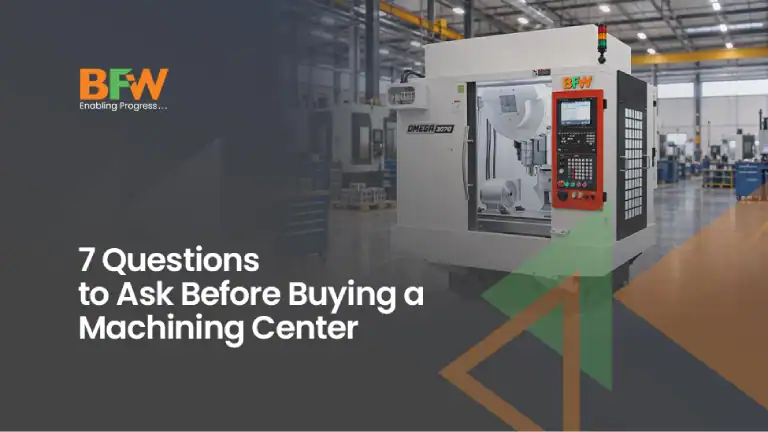
Every machining center you invest in has a direct impact on your business beyond the shop floor. It influences production capacity, delivery commitments, operating costs, and your ability to take on new opportunities. Choosing the right machine is a strategic investment that can shape your manufacturing operations for years to come.
The real question isn’t, “Which machining center is the best?”
It’s, “Which machining center is the right fit for the way my business operates today and where it needs to go tomorrow?”
Taking the time to ask the right questions before investing can help you choose a solution that truly supports your business goals.
1. What Are You Really Trying to Produce?
Every manufacturing facility is different. A machine that’s ideal for a high-volume automotive production line may not be the best choice for a shop handling low-volume, high-mix precision components.
Before evaluating machines, take a step back and assess your production requirements.
Ask yourself :
- What types of components will the machine produce?
- What materials do you work with – steel, aluminium, cast iron, titanium, or specialty alloys?
- Are your parts becoming more geometrically complex?
- Do you anticipate tighter tolerances in future projects?
- Are batch sizes likely to increase or become more varied?
The answers will help determine the machine configuration, rigidity, spindle capabilities, and overall performance you’ll actually need.
2. Will This Machine Support Your Business Five Years From Now?
Production requirements rarely stay the same.
New customers bring different component designs. Industries evolve. Automation becomes more common. Capacity expectations increase.
A machining center purchased solely for today’s workload can quickly become a bottleneck if it lacks the flexibility to grow with your business.
Consider questions such as :
- Will this machine support future product lines?
- Can it accommodate more complex machining requirements?
- Is it compatible with automation or robotic loading if needed later?
- Can it integrate with digital manufacturing initiatives as your operations expand?
3. What Is the Actual Cost of Ownership?
When comparing machining centers, it’s important to evaluate the investment over the entire lifecycle of the machine rather than focusing solely on the initial quotation.
Factors worth considering include :
- Maintenance requirements
- Availability and cost of spare parts
- Energy consumption
- Tool life
- Machine uptime
- Preventive maintenance schedules
- Overall reliability
A lower purchase price can sometimes translate into higher operating expenses if the machine experiences frequent downtime or requires costly repairs.
4. How Reliable Will the Machine Be During Continuous Production?
When evaluating a machining center, pay attention to factors such as :
- Structural rigidity
- Thermal stability
- Repeatability over long production runs
- Vibration control
- Build quality
- Consistency under demanding operating conditions
These characteristics directly influence machining accuracy, surface finish, tool life, and the machine’s ability to maintain performance over extended periods.
5. What Happens After the Machine Is Installed?
Even the most advanced machining center delivers its full value only when operators are trained, processes are optimized, and support is readily available.
Before making your decision, understand what comes after installation :
- Operator training
- Process and application support
- CNC programming assistance
- Commissioning services
- Preventive maintenance
- Remote diagnostics
- Technical consultation when new components are introduced
6. How Strong Is the Service and Support Network?
Every machine will eventually require service. The difference lies in how quickly production returns to normal.
When evaluating suppliers, consider :
- Availability of local service engineers
- Response times
- Spare parts inventory
- Preventive maintenance programs
- Annual maintenance contracts
- Technical expertise
Choosing a machining center also means choosing the people who will support it throughout its operating life.
7. Is the Machine Ready for Future Manufacturing Technologies?
Automation, machine monitoring, digital production planning, and Industry 4.0 technologies are steadily becoming part of everyday operations.
Before investing, ask :
- Can the machine integrate with automation solutions?
- Is it compatible with production monitoring systems?
- Can it support future digital initiatives without extensive modifications?
Selecting equipment that is prepared for evolving manufacturing practices protects your investment and allows your business to adopt new technologies at its own pace.
Common Buying Mistakes to Avoid
Even experienced manufacturers can overlook important considerations during the buying process.
Some of the most common mistakes include :
- Choosing the lowest quotation without evaluating long-term operating costs.
- Purchasing more machine capacity than current or future production requires.
- Focusing only on spindle speed while overlooking overall productivity.
- Underestimating the importance of service support.
- Ignoring operator training and application engineering.
- Selecting a machine for today’s requirements without considering future growth.
Avoiding these pitfalls often leads to better returns over the machine’s lifecycle.
Making the Right Investment Decision
The right machine should deliver consistent performance, adapt to changing production needs, minimize downtime, and support your business as it grows.
By asking the right questions before making your decision you are evaluating how well a machining solution fits your production goals, your people, and your future.
Because in manufacturing, the best investment isn’t always the machine with the biggest numbers on a specification sheet. It’s the one that keeps your shop floor productive, your customers satisfied, and your business moving forward for years to come.
Continue exploring our knowledge hub for practical insights on machining technologies, production efficiency, and manufacturing innovation.