Graphite electrodes are used in electric arc furnaces (EAF) to melt scrap metal for steel production. They
conduct high-voltage electric current, generating the intense heat required for the melting process.
Known for their excellent electrical conductivity, thermal resistance, and mechanical strength, graphite
electrodes are essential for efficient, high-temperature steelmaking. They also play a key role in ladle
furnaces for refining molten steel and are critical in maintaining consistent quality and productivity in
modern steel plants. As a consumable item, each electrode rod is gradually consumed during the
process, making its quality and machining accuracy vital for uninterrupted operations.
About the Client:-
The client manufactures graphite electrodes used in electric arc furnaces (EAF) for steel production.
These electrodes conduct high-current electricity to generate the intense heat required to melt scrap
metal. The production process begins with baking the electrode component, followed by a
graphitization phase that hardens the material and prepares it for final machining. Once graphitized, the
material becomes significantly tougher, requiring high-precision CNC machining. The client supplies
these electrodes in various sizes and grades, primarily to export-oriented steelmakers, ensuring
exceptional conductivity, thermal resistance, and durability in demanding high-temperature
environments.
Client Requirement & Challenge
- The client needed a customized solution to machine large graphite rods used in electric arc furnaces.
- The components ranged from Ø200 mm to Ø840 mm in diameter and 1200 mm to 3200 mm in length, with weights between 1200 kg and 3.2 tonnes.
- The application involved multiple machining operations in a dust-intensive environment due to the nature of graphite.
- A centralized dust extraction system is available at the customer site to manage airborne particles effectively.
Key Challenges
- Perform the following operations
- Outer diameter Scraping & End Facing (PLC Machine)
- Centering (CNC Machine)
- OD Turning (cnc machine)
- Face milling ,Taper boring and threading (CNC Machine)
- Handle heavy and brittle graphite components without causing damage.
- Ensure high operator safety during the machining process.
- Control and contain graphite dust effectively to maintain a clean work environment.
BFW’s Custom Solution for Graphite Rod Machining
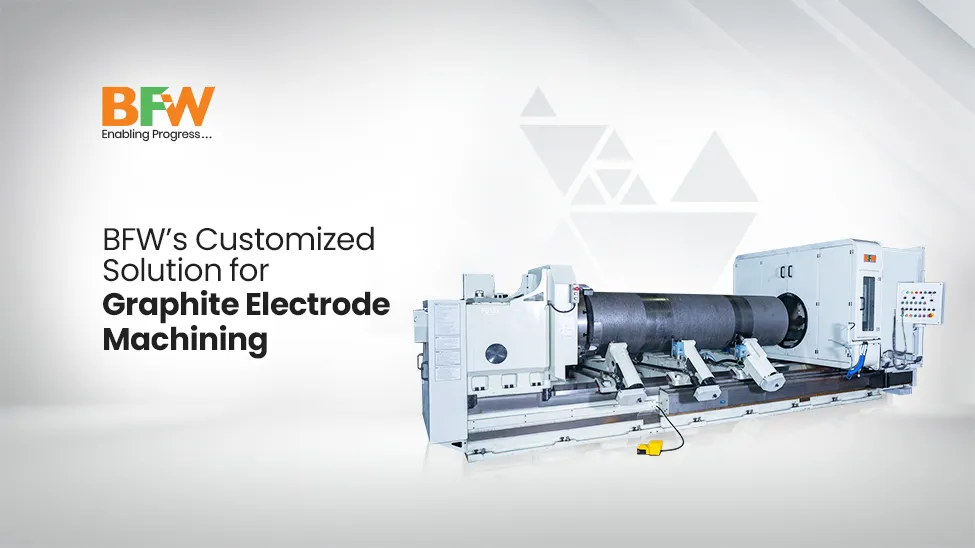
To address the client’s requirement for machining large graphite components used in electric arc
furnaces, BFW developed customized PLC & CNC Machine designed for high-precision operations in a
dust-intensive environment. The machine handles parts ranging from Ø200 mm to Ø840 mm in
diameter, 1200 mm to 3200 mm in length, and weighing up to 3200 kg.
Key Features & Solution Highlights
- Robust Work Handling
A highly rigid chain conveyor transfers the baked part into the machines through an automatic
door system. Within the machining zone, a walking beam carries the component forward. Two
rollers positioned at either end of the part enable rotation for diameter scraping.
Next, a lifter mechanism transfers the component onto the walking beam, which leads to a
gravity conveyor. From this point, the component is manually lifted using a crane and loaded
onto the end-facing machine.
After end facing, the part undergoes graphitization. Post-graphitization, it is loaded onto a CNC
machine for the first centering operation. This is followed by OD turning on a second CNC
machine, and finally, taper boring and threading on a third CNC machine.
- Multi-Operation Capability
The initial stage of graphite production involves machining baked parts. For this, two PLC-based
machines are used to perform surface scraping and face milling. After these operations, the
baked part undergoes graphitization.
Post-graphitization, the component requires precision machining, which is carried out on three
CNC machines to ensure accurate dimensions and tight tolerances. In total, five machines are
used in the process—two PLC machines for initial operations and three CNC machines for
precision machining.
- Advanced Machine Bed
- Heavy-duty bed with 30° & 60° V guideways and flat guideways for rigidity.
- Integrated dust pockets with removable trays for efficient graphite powder management.
- Optimized Headstock & Chuck CNC System
- Siemens 6.3 kW motor with a two-speed gear train delivering 4–120 rpm and up to 2500 Nm torque.
- Air purge at spindle front prevents graphite dust ingress.
- Precision Boring & Threading Unit
- Servo-driven slide and spindle with AC squirrel cage motor (30 kW).
- Labyrinth seals and air purge ensure dust protection and bearing life.
- High-Performance Face Milling Unit
- A2-6 spindle with 30 kW motor and precision bearings.
- Similar dust-proof design and belt-driven architecture as the boring unit.
- Component Loading & Alignment
- Manual placement on work rests with automatic alignment to spindle axis post clamping.
- Electronically synchronized quills on the steady rest ensure accurate centering across diameters.
- Tooling & Dust Extraction
- Special cutting tools and holders provided by the client.
- Common cutter hood with dust extraction interface ensures clean machining.
- Protection & Safety
- Telescopic covers for ball screws and protective sheet metal on critical components.
- Dust extraction hood integrated with boring and milling units.
- Dedicated Utility Setup
- Electrical units, hydraulic power pack, and transformer housed in an isolated AC cabin to prevent graphite dust exposure.
- Remote operator panel with transparent door and MPG for easy control access.
- Control & Monitoring
- Siemens 828D CNC system with integrated IRIS software for data collection.
- Montronix overload protection on key axes and spindle for deep cuts and heavy-duty machining.
Conclusion
BFW’s custom CNC and PLC solution enabled high-precision, multi-operation machining of large graphite
Components, while ensuring effective dust control and operator safety. This project showcases BFW’s
expertise in delivering reliable, application-specific solutions that drive productivity and efficiency in
challenging environments.